A Roth IRA has no minimum age. I think most people assume it does, and that's a fair thing to assume, because everything about a retirement account sounds like adult business. But the rule isn't about age. It's about earned income. If a 12-year-old earns money, a 12-year-old can have a Roth IRA.
The account behaves the way it always does. You put in money you've already paid tax on, it grows tax free, and you take it out tax free in retirement. What changes for a kid is the runway. Fifty years of compounding does something that twenty-five years doesn't, and the gap between them is wider than it sounds.
How it works
Minors can't hold a brokerage account in their own name, so a parent opens a custodial Roth IRA and runs it until the kid hits the age of majority, which is 18 or 21 depending on the state. At that point it becomes a normal Roth IRA in their name. Fidelity, Schwab, and Vanguard all offer them with no account fees and no minimums.
The earned income part is where people trip up. The kid needs real, documentable earned income, and you can't contribute more than the lesser of what they earned or the annual limit, which is $7,500 in 2026.
W-2 jobs are the easy case. A summer lifeguarding gig or a few shifts a week bagging groceries works exactly the way you'd expect. Self-employment counts too, so babysitting, lawn mowing, tutoring, snow shoveling, and dog walking all qualify, though once that income passes $400 it triggers self-employment tax and belongs on a Schedule C. If you own a business you can hire your kid for real, age-appropriate work at a reasonable wage, and that wage is earned income like any other. Allowance isn't. Birthday money from grandma isn't. Neither is investment income.
Keep records either way. For informal work, a notebook with dates, what they did, who paid, and how much is plenty. You're not filing it anywhere. You just want to be able to show the income was real if anyone ever asks.
Two things about this account surprise people. The first is that the money going in doesn't have to be the kid's money. If your 15-year-old earns $3,000 mowing lawns, they can spend all $3,000 and you can put $3,000 into their Roth. The limit is set by how much was earned, not by whose dollars make the trip. Plenty of families run it as a match: the kid keeps their paycheck, the parents fund the account up to what the kid brought in.
The second is that a kid earning a few thousand dollars owes no federal income tax on it anyway, since the standard deduction is $16,100 in 2026. So the money isn't taxed going in, and it won't be taxed coming out. That's rare. Most of us pay on one end or the other.
What it actually does
Every number below assumes 10.3% a year, which is the S&P 500's annualized total return over the last 30 years with dividends reinvested. It isn't adjusted for inflation, so these are future dollars, and $1.5 million in 2076 won't buy what $1.5 million buys today. The next 50 years won't copy the last 30 either. The shape of these numbers is the point. The digits aren't.
Leo. His parents match $1,000 a year of his summer earnings from 14 through 18. Five contributions, $5,000 in total, then nothing. The account holds about $6,800 the year he turns 18, which is not a number that impresses anyone. At 65 it's worth about $616,000, tax free. Five thousand dollars, roughly a used trailer and a few summers of gas money, turns into a six-figure retirement account several times over.
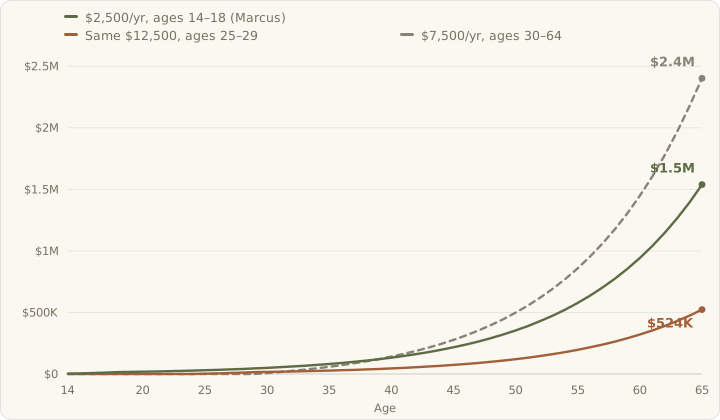
Marcus. Same idea, bigger match. His parents put in $2,500 a year from 14 through 18, $12,500 total, and then they stop for good. He never adds a cent himself. At 65 those five summers are worth about $1,540,000.
The comparison is the part worth staring at. If that identical $12,500 had gone in from 25 through 29 instead, it would be about $524,000 at 65. Same money, same return, eleven years later, roughly a third of the result.
For a different kind of scale: someone who starts at 30 and puts in $7,500 every year until 65 contributes $262,500 of their own money and lands around $2,400,000. Marcus got about two thirds of that outcome for about 5% of the cash, because his dollars had five extra decades to work.
Ava. Her family runs a small business and she does real, documented work in it from the time she's a toddler, starting as a baby modeling for the company's marketing and moving on to filing, cleaning, and eventually the register. Her parents pay her a reasonable wage for that work and max her custodial Roth at $7,500 every year for 18 years, $135,000 in total. At 18 the account is around $389,000. If she never contributes again it reaches roughly $35 million by 65. If she simply keeps maxing it through her working life it passes $42 million, and more than 80% of that traces back to the years before she could vote. Forty-six years of adult contributions add less to the final number than those first 18 did.
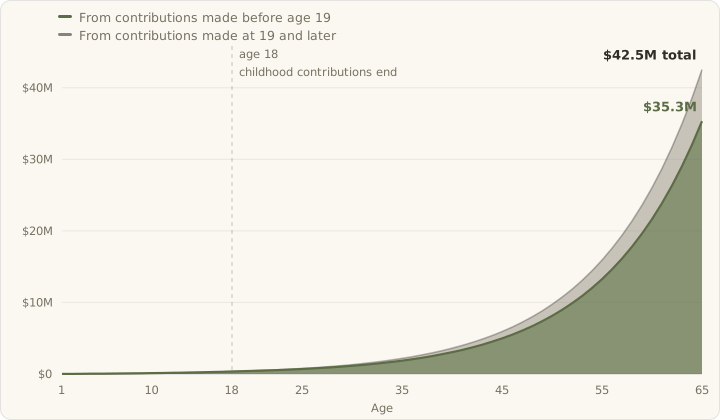
Ava's version takes a family business and careful paperwork, and it's rare for good reason. But it's legal, and it marks the ceiling. You don't need to get anywhere close to it for the idea to hold.
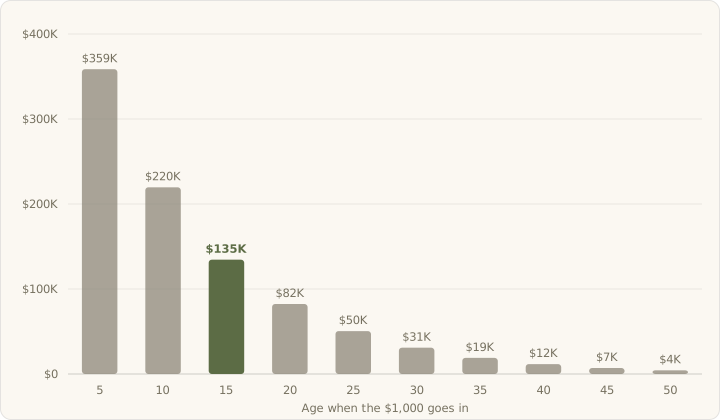
Which brings me to the one number I'd keep if I had to throw out the rest. A single $1,000 contribution at 15 is worth about $135,000 at 65. Not $1,000 a year. One thousand dollars, once.
One more way to fill it
If your kid also has a 529 with money left after school, the SECURE 2.0 Act lets you roll up to $35,000 of it into their Roth IRA, tax free and penalty free, spread over several years. It pairs well with everything above, and the 529 side of it, including using one account to put multiple generations through school, is long enough to deserve its own post.
Getting started
The account waits on earned income, but that shows up earlier than most parents expect, and opening one at Fidelity or Schwab is no harder than opening a regular brokerage account.
None of this is clever. Open the account, write down what the kid actually earned, put in that much or the annual limit, whichever is smaller, and buy a low-cost index fund. Then leave it alone for forty years, which is genuinely the hard part.
This post is for general information, not personalized financial or tax advice. Contribution limits, income rules, and tax treatment change and vary by situation, so confirm the current numbers or talk to a professional before making moves.