A 529 has a reputation as a single-purpose account. You fill it up over eighteen years, you drain it for tuition, and then you're done with it. Until a few years ago that was mostly accurate.
It isn't anymore. Between the SECURE 2.0 Act and a couple of tax changes since, one account can pay for school, move what's left into your kid's Roth IRA, and then keep compounding for grandchildren who don't exist yet. Same account, no tax at any step.
How a 529 works
It's a state-sponsored investment account for education. You put in money you've already paid tax on, invest it in funds, and the growth comes out tax free as long as it goes toward qualified education expenses. If $50,000 of contributions turns into $120,000 by the time your kid starts college, that $70,000 of growth arrives without a federal tax bill.
Qualified expenses cover more ground than they used to. Tuition, fees, room and board, books, and computers were always in. K-12 costs are now covered up to $20,000 a year, double the old $10,000 limit, and that category has widened past tuition to include curriculum materials, tutoring, and standardized test fees. The 2025 federal tax law also opened 529s to career credentialing, so welding certifications, CDL training, cosmetology school, and CPA exam fees qualify now. Trade school already did. The old complaint about 529s, that they only pay off if your kid takes the four-year-college route, mostly doesn't hold anymore.
You can use any state's plan regardless of where you live, but check your own state first. More than 30 offer a state income tax deduction or credit for using theirs, and that's real money you'd skip by defaulting to a popular national plan like Utah's my529 or New York's.
Contributions are gifts to the beneficiary, so the annual gift tax exclusion applies. That's $19,000 per person per beneficiary in 2026, which means a married couple can put in $38,000 a year per kid without any paperwork. If you want a large sum compounding early, superfunding lets you front-load five years of gifts at once, up to $95,000 per person or $190,000 per couple. One gift tax form, no tax owed.
And you keep control the whole time. Your kid is the beneficiary, but you decide when money comes out and what it goes toward. You can also change the beneficiary to another family member. That last part matters more than it sounds, and I'll come back to it.
What if they don't use it?
This is the objection that stops people from opening 529s at all, so here's the direct version. Money withdrawn for anything other than qualified expenses gets the earnings portion taxed as income, plus a 10% penalty. That used to be a genuine risk if your kid landed a scholarship, skipped college, or just didn't need the whole balance.
The SECURE 2.0 Act took most of the risk out. Since 2024 you can roll leftover 529 money straight into a Roth IRA owned by the beneficiary, tax free and penalty free. It goes from a tax-free education account to a tax-free retirement account without stopping at the IRS.
The fine print matters here, and one piece of it should change what you do today:
The lifetime cap is $35,000 per beneficiary. The account has to have been open at least 15 years, which is the best reason to open one at birth rather than waiting. Contributions from the last five years, and their earnings, can't be rolled. Each year's rollover is limited to that year's Roth contribution limit, $7,500 in 2026, so clearing the full $35,000 takes about five years. And the beneficiary needs earned income at least equal to whatever gets rolled that year, same as any Roth contribution.
The practical upshot is that overfunding a 529 stopped being a mistake. Up to $35,000 of extra college money now has somewhere to land. Some parents have started opening 529s partly for that reason, treating it as an education account with a retirement account bolted on the back.
What that looks like
Same assumption I use everywhere: 10.3% a year, which is the S&P 500's annualized total return over the last 30 years with dividends reinvested. It isn't adjusted for inflation, so these are future dollars. Nobody knows what the next 30 years hold.
Emma's parents open a 529 the month she's born and put in $3,000 a year for 18 years, $54,000 total. At 10.3% that's around $155,000 when she turns 18. She uses most of it for school, and her parents roll the remaining $35,000 into her Roth IRA at $7,000 a year from 19 through 23, while she's working through college and her first job. She never adds another dollar to that Roth. At 65 the rollover money alone is worth about $2,640,000. Her education got paid for, and the leftovers turned into a seven-figure retirement account.
After college is paid for
So what happens to money still sitting there once school is covered and the full $35,000 has gone into a Roth?
Nothing, if you want. The account has no expiration date, and that's the piece people miss. You can change the beneficiary to another family member at any time with no tax and no penalty, and the list of eligible people is wide: siblings, first cousins, nieces and nephews, parents, and the beneficiary's own future children.
That last one is the interesting one, because it means a 529 doesn't have to end when your kid graduates. Leftover money can sit there compounding tax free until the next generation needs it. Say your daughter finishes school, rolls her $35,000 into a Roth, and $30,000 stays behind. Leave it alone and at 10.3% it's about $348,000 in 25 years, which is roughly when her own kids would be looking at college. Leave it 40 years and it's over $1.5 million.
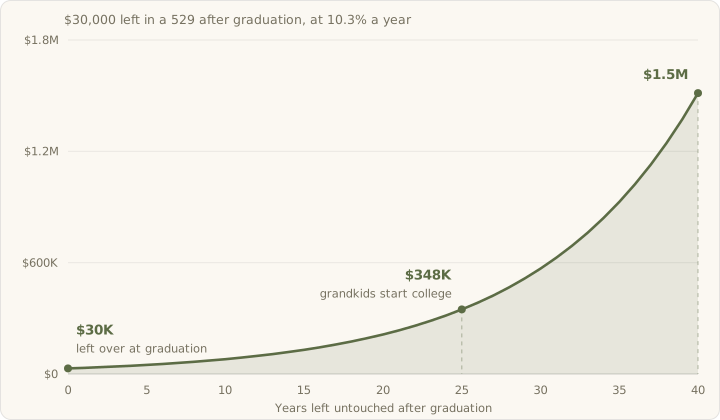
The account that put your kid through school ends up putting your grandkids through school, funded by contributions you made decades earlier and then never thought about again.
People who do this on purpose call it a dynasty 529: one account, or a set of them, handed down by beneficiary change, paying for education generation after generation, with each new beneficiary potentially eligible for their own Roth rollover later on.
Two cautions before you build a plan around it. Changing the beneficiary to someone a generation down can count as a gift, which given today's exemptions usually means paperwork rather than a tax bill, but you should know it's there. And the IRS hasn't clarified how beneficiary changes interact with the 15-year clock for Roth rollovers, so I wouldn't lean on that specific combination until the guidance firms up.
One more thing, if the scholarship case is what's worrying you. If your kid earns a scholarship you can withdraw up to the scholarship amount without the 10% penalty. You'll owe ordinary income tax on the earnings portion, but the penalty is waived, so a scholarship never traps your money.
Getting started
Opening one takes about 15 minutes online, through your own state's plan or a national one. Inside the account, a low-cost index fund is all the strategy a multi-decade timeline needs. And if your kid has earned income, this pairs naturally with a custodial Roth IRA, which is a big enough subject that it has its own post.
If you're going to do it, do it early, and not mainly for the compounding. It's the 15-year clock. An account opened this month with $50 in it buys more future flexibility than a $5,000 account opened when your kid is a sophomore in high school.
This post is for general information, not personalized financial or tax advice. Contribution limits, income rules, and state tax treatment change and vary by situation, so confirm the current numbers or talk to a professional before making moves.